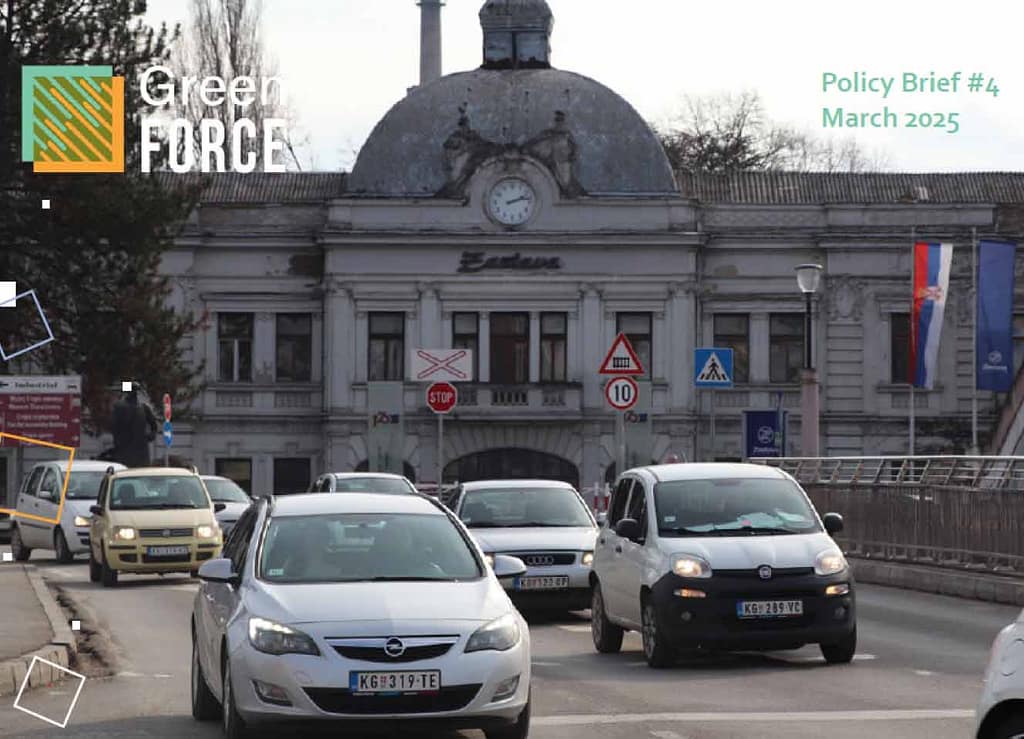
Shifting Gears: Advancing Green and Inclusive Mobility in Western Balkan Cities
Urban mobility in the Western Balkans is at a crossroads. As cities grow, so do traffic congestion, air pollution, and inequality in access to transport. GreenFORCE’s latest Policy Brief explores how medium-sized cities—using the City of Kragujevac, Serbia, as a case study—can take meaningful steps toward greener, more inclusive mobility systems that benefit both people and the planet.
The brief presents an assessment of Kragujevac’s current transport system, highlighting common challenges across the region: over-reliance on outdated diesel buses, car-dominated infrastructure, limited cycling and pedestrian options, and rising environmental and health costs. Simultaneously, it offers practical solutions that can be applied across other Western Balkan cities.
At the heart of the brief are three policy scenarios ranging from low-effort interventions to ambitious reforms. These include the introduction of free electric bus lines in city centers, parking restrictions to discourage private car use, and congestion pricing to reduce traffic and pollution. A cost-benefit analysis shows that the most ambitious scenario—not only the most environmentally friendly—is also the most economically viable in the long run.
Citizen input plays a key role in shaping these proposals. Based on a survey of 424 Kragujevac residents, the brief captures local perspectives on public transport quality, revealing a strong demand for more frequent, reliable, safe, and comfortable services. Remarkably, 90% of respondents expressed willingness to use electric buses, showing strong public support for cleaner alternatives.
The policy brief goes beyond technical fixes. It emphasizes the importance of institutional reform, improved governance, cross-sector coordination, and public engagement. It also outlines the need for cities to strengthen their capacity to access and manage EU funds, leverage public-private partnerships, and embed sustainability principles in urban planning.
Ultimately, the message is clear: the transition to sustainable urban mobility is not only possible—it’s necessary, and it can bring wide-reaching benefits for public health, social equity, and local economies.
To read full publication click here.
To read full publication in Serbian click here.